


Open-book costing renovation — a North Bristol rectory brought into the 21st century
A historic North Bristol rectory reconfigured for modern family life — and costed on an open-book from start to finish.
.jpeg)
At a glance
Location: North Bristol
Property: Former rectory
Scope: Open-plan kitchen-dining reconfiguration, garden opening, chimney breast removal, internal layout changes, two new en-suite bathrooms, additional family bathroom
Costing model: Open-book
The client
The clients had bought a former North Bristol rectory — a generous, characterful house with a striking hallway, original staircase and rooms with the kind of proportions that newer homes simply don't offer. The bones were exceptional. The kitchen and dining layout, though, was firmly stuck in another century.
A vast chimney breast sat awkwardly in the middle of the kitchen-diner, breaking up what should have been the most generous social space in the house. The connection to the garden was minimal. The whole ground floor was working against family life.
The challenge
Two questions sat behind this Bristol renovation project. First, the structural one: could we remove the chimney breast and create a meaningful opening to the garden without compromising the integrity of a historic building? Second, the financial one: how do you give a client genuine confidence that they're getting value on a six-figure project?
Most builders answer the second question with a fixed quote and a hope that nothing changes. We don't think that's good enough on a project where decisions are still being made as work progresses.
Our approach: open-book costing in practice
We costed this Bristol renovation project on an open-book basis. Every supplier quote, every trade rate and every material cost was shared with the clients in full. They saw what we paid. They saw our margin. They saw exactly where their money was going.
Open book costing isn't standard practice in residential construction in Bristol or anywhere else. It takes more administration on our side and more trust on both sides. But for clients who want genuine certainty on a six-figure project, it's the most honest model available.
There are no hidden margins. No nasty surprises mid-project. No reason for either side to be defensive about money. And it leads to better decisions: when clients see real costs in real time, they can weigh trade-offs sensibly — spend more here, less there — rather than guessing at what's buried in a fixed quote.
Find out more about how our open book costing model works and whether it's right for your project.
The result
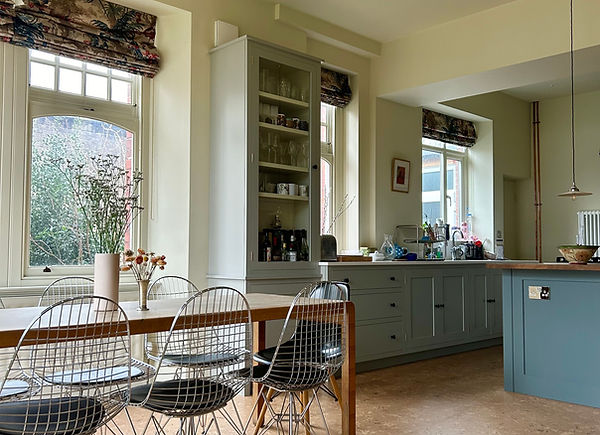
The chimney breast was removed and the walls opened up, creating a large kitchen-dining space flooded with light. A generous opening was cut through to the garden — the connection the ground floor had always needed. Bedroom layouts were reworked upstairs to add two new en-suites and a new family bathroom, turning a house that had felt underused into one that works properly for a modern family.
And throughout, the clients knew exactly what everything cost. No invoice arrived without context. No line item was a surprise. The open book model meant that every decision the clients made — to upgrade a fitting, to amend a detail, to spend more or less in a particular area — was made with full information. That's a fundamentally different experience from the standard fixed-price model.
Curious how open-book costing works?
It's not the right fit for every project — but on substantial Bristol renovations, it can be the difference between trusting your builder and second-guessing every invoice. We'd be glad to talk you through it.


What is open-book costing?
Open-book costing (also called cost-plus or transparent costing) is a model in which the builder shares every cost with the client — supplier quotes, trade rates, material invoices and contractor margin — in full. The client sees exactly where their money goes. There are no hidden margins. On large or complex renovation projects, it's the most transparent and often most cost-effective model available.
What is open-book costing in construction?
Open-book costing is a pricing model in which the contractor shares all project costs — labour, materials, subcontractor quotes and their own margin — with the client in full. The client pays actual costs plus an agreed management fee or percentage, rather than a fixed price that buries costs inside the quote. It's also called cost-plus or transparent costing.
Is open-book costing more expensive than a fixed-price builder?
Not necessarily — and often less so. Fixed-price contractors build contingency and risk into their quotes; you're effectively paying for their insurance against unknown costs. With open book costing, savings on materials or trades pass directly to you. The trade-off is that final costs aren't guaranteed upfront. On complex or high-value projects, open book often delivers better value than a fixed quote padded for uncertainty.
Which Bristol renovation projects suit open-book costing?
Open-book costing works best on larger projects (typically £80,000+) where scope is complex, materials are high-value, or the brief is still evolving at the point of engagement. It's particularly suited to historic buildings, rectories, and properties with structural unknowns — where a fixed quote would either be padded heavily or would fall apart when surprises emerge.
How does Space's open book costing model work in practice?
We share every supplier quote and trade rate with clients before committing spend. We provide a running cost tracker updated throughout the project. Our management fee — either a fixed amount or a percentage of build cost — is agreed and transparent upfront. Clients can see our margin. Most find that seeing the actual numbers builds more confidence than any fixed quote would.